RESEARCH-GRADE PEPTIDES
Curious about peptides?
Start here.
You’ve probably been hearing a lot about peptides—but what can they actually do? Scroll down to discover our personal journeys, explore the 5 Pillars of Peptide Therapy, and hear from real people sharing their experiences and results.
THE FOUNDERS
Here Is How Peptide Therapy Helped Us!
We will never shut up about Peptides. They have totally changed our lives and the longer we are on them the better we continue to feel. Watch our stories below.
Teri
After experiencing significant metabolic changes following prolonged mold exposure—including unexplained weight gain, fatigue, and insulin resistance—I began researching peptide therapy as part of a more targeted approach to supporting my health. Despite maintaining a healthy diet and consistent exercise routine, I had struggled for nearly a year to lose the weight I had gained. In this video, I share my personal experience with peptide therapy, including a 30 pound weight loss, improvements in body composition, increased energy, and measurable changes in my metabolic health. I also discuss how this experience shaped the individualized, education-focused approach I now use when helping women explore peptide therapy as part of their broader health and wellness strategy.
Mark
After years of chronic sciatic pain, inflammation, joint discomfort, limited mobility, and weight gain, Mark felt like his body was experiencing what his doctor described as “managed decline.” At nearly 60, he decided to explore peptide therapy as part of a more targeted approach to his health. Within 90 days, Mark lost 31 pounds, and after approximately six and a half weeks, he reports that the sciatic pain he had lived with for four years was gone. In this video, Mark shares his personal experience with peptide therapy, including changes in his weight, inflammation, mobility, pain, and overall quality of life—and why his results inspired him to continue learning about peptides and helping others explore whether peptide therapy may be appropriate for their own wellness goals.
THE FOUNDERS
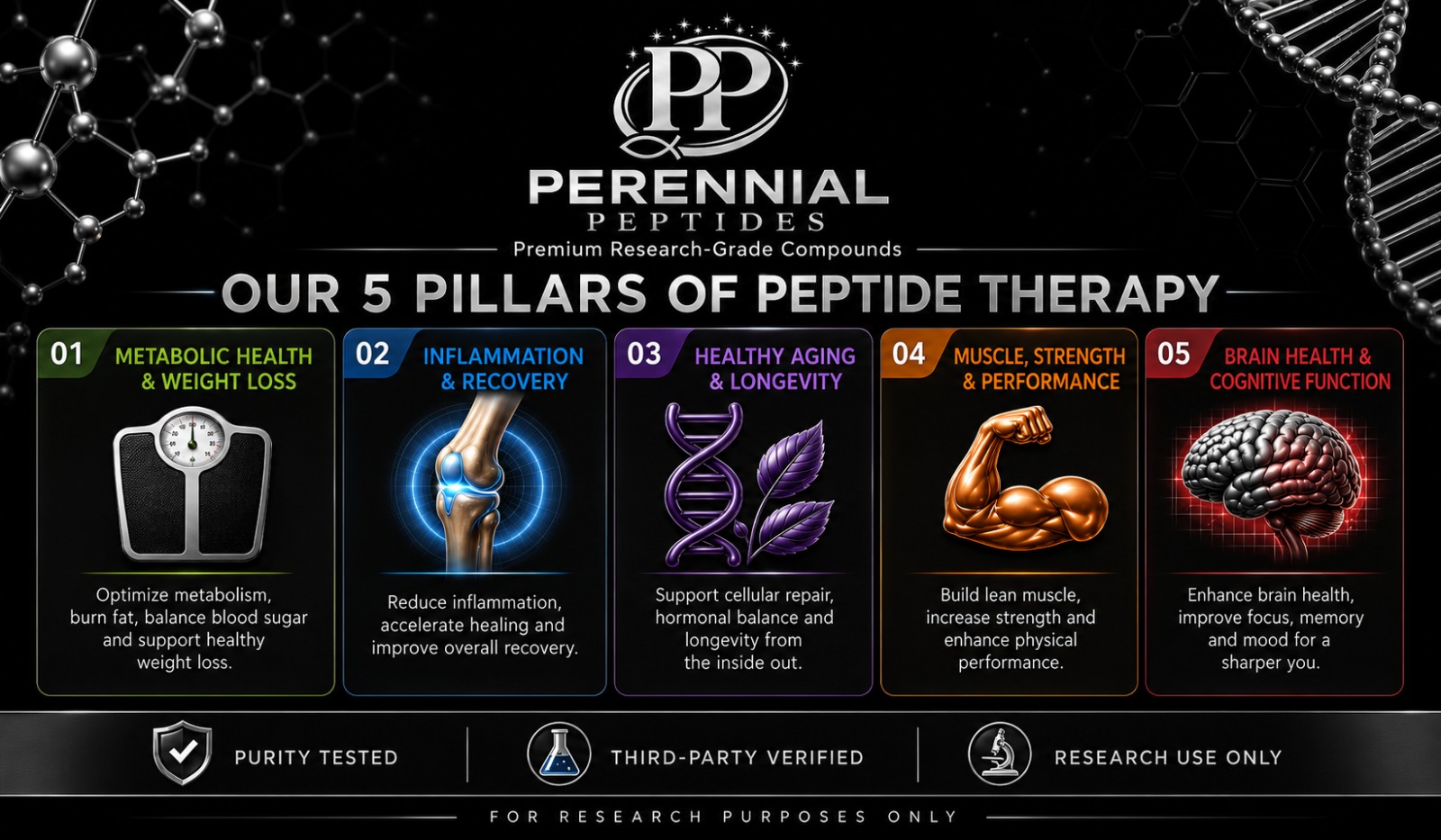
Our 5 Pillars of Peptide Therapy
Targeted Peptides. Total Body Transformation.
Peptide research is often approached by asking, “Which peptide does what?” Our 5 Pillar of Peptide Therapy provide a different framework—one centered on the biological systems we are trying to understand and support.
The human body does not function as a collection of independent systems. Metabolism influences inflammation, inflammation affects recovery, mitochondrial health influences energy production, sleep affects hormonal signaling, muscle influences glucose metabolism, and metabolic health can affect brain function.
Many peptides are studied as signaling molecules—small messengers that interact with receptors and biological pathways. Rather than thinking of a peptide as something that simply “does a job,” it can be more useful to think about the signal it influences and the pathway that signal affects.
This also explains the research interest in carefully designed peptide combinations, or “stacks.” Compounds that influence complementary pathways may allow researchers to examine a biological system from several directions rather than focusing on one isolated mechanism.
Our five pillars organize those interconnected areas into a simple framework.
PILLAR 1
Metabolic & Weight Loss Pillar
Understanding Metabolism Beyond Calories
Weight management is often reduced to a simple equation of calories consumed versus calories burned. Energy balance certainly matters, but metabolic health involves far more than calorie intake alone.
The body must continuously determine how energy will be used, stored and mobilized. That process involves communication among the brain, digestive system, pancreas, liver, muscles, fat tissue and mitochondria.
Important components include appetite and satiety signaling, glucose regulation, insulin sensitivity, mitochondrial energy production, fat metabolism, metabolic flexibility and preservation of lean tissue.
A Multi-Pathway Approach to Metabolic Research
The Metabolic Health & Weight Loss Pillar brings together research areas that approach metabolism through complementary mechanisms.
One pathway may influence signals associated with hunger and fullness. Another may be investigated for glucose metabolism and insulin signaling. Other pathways may involve mitochondrial function, cellular energy production, fat utilization or body composition.
The potential synergy comes from examining several pieces of the metabolic system together.
For example, reducing appetite alone does not necessarily improve mitochondrial function. Increasing cellular energy production does not automatically address excessive hunger. Supporting fat metabolism does not necessarily correct impaired glucose signaling.
These are different biological processes, yet they continuously interact.
Why Mitochondria Matter
Mitochondria are microscopic structures within cells responsible for producing much of the energy the body uses. They therefore play an important role in metabolic research.
Healthy mitochondria help cells convert nutrients into usable energy. Researchers are increasingly interested in how mitochondrial signaling, oxidative stress and metabolic flexibility may influence overall metabolic health.
This makes metabolic research about much more than simply losing pounds.
The larger objective is understanding how the body regulates energy, appetite, glucose, fat storage, fat utilization and cellular function as an interconnected system.
The focus of Pillar 1: creating a more complete picture of the biological signals involved in metabolic health and body composition.
PILLAR 2
Inflammation & Recovery
Inflammation Is Not Always the Enemy
Inflammation is often described as something that should simply be eliminated. In reality, inflammation is an essential part of the body's normal defense and repair response.
When tissue is injured, inflammatory signals help alert the immune system and initiate processes involved in repair.
The problem arises when inflammatory signaling becomes excessive, prolonged or poorly regulated.
Recovery itself is also much more complicated than reducing inflammation. The body may need to repair connective tissue, support blood vessels, manage oxidative stress, regulate immune activity, restore cellular energy and communicate with the nervous system.
Supporting the Recovery Environment
The Inflammation & Recovery Pillar therefore examines several interconnected research areas, including:
Inflammatory signaling, tissue-repair pathways, connective-tissue health, oxidative stress, immune regulation, nerve-related pathways, gut signaling and cellular energy production.
This is where a multi-pathway approach becomes especially interesting.
One research compound may influence signaling associated with tissue repair, while another may be investigated for inflammatory pathways. Another may influence nerve-related mechanisms, antioxidant defenses or immune signaling.
Rather than expecting one pathway to accomplish everything, the goal is to better understand the entire biological environment surrounding recovery.
Recovery Requires Energy
An often-overlooked component of healing is cellular energy.
Repairing tissue is biologically expensive. Cells need energy to communicate, synthesize proteins, maintain membranes and perform the countless processes involved in recovery.
This creates an important connection between inflammation, mitochondrial function and tissue repair.
It also explains why certain research compounds naturally cross over between the Inflammation & Recovery, Metabolic Health, Performance and Healthy Aging pillars.
The focus of Pillar 2: understanding how inflammatory regulation, cellular protection, immune signaling and tissue-repair pathways work together to create an environment that supports recovery.
PILLAR 3
Health Aging & Longevity
Longevity Is About Healthspan, Not Simply Lifespan
Healthy aging is sometimes associated primarily with appearance—better skin, fewer wrinkles or looking younger.
Those may be visible aspects of aging, but longevity research goes much deeper.
The more meaningful question is not simply:
How long can we live?
It is:
How well can the body continue to function as we age?
This concept is often called healthspan—the portion of life spent functioning with health, strength, independence and vitality.
What Changes as We Age?
Aging involves changes across many biological systems.
Mitochondrial efficiency can decline. Oxidative stress can accumulate. Cellular repair mechanisms may become less efficient. Collagen production changes. Immune function changes. Hormonal signaling changes, and the body's ability to recover from physical stress may decline.
For this reason, the Healthy Aging & Longevity Pillar examines research involving several areas simultaneously:
Cellular energy production, mitochondrial function, DNA and cellular repair, antioxidant defenses, immune regulation, connective-tissue health, skin regeneration and healthy hormonal signaling.
Cellular Resilience Is Central to Healthy Aging
One of the major themes connecting these areas is cellular resilience.
Healthy cells must be able to produce energy, respond to stress, repair damage, communicate appropriately and maintain normal function.
Research into longevity therefore increasingly looks beyond individual organs and examines what is happening at the cellular and mitochondrial level.
This also explains why compounds associated with longevity frequently cross into other pillars. Supporting mitochondrial function, for example, may be relevant to healthy aging but may also influence metabolism, exercise capacity, recovery and brain energy.
The systems cannot be completely separated because aging affects the entire body.
The focus of Pillar 3: exploring biological pathways associated with maintaining cellular function, resilience, repair and vitality throughout the aging process.
PILLAR 4
Muscle, Strength & Performance
Muscle Is About Much More Than Appearance
Muscle is frequently discussed in terms of fitness or aesthetics. From a health and aging perspective, however, maintaining muscle and strength has much broader significance.
Skeletal muscle is metabolically active tissue.
It plays an important role in glucose utilization, insulin sensitivity, mobility, physical function, metabolic rate and overall body composition.
Maintaining strength also becomes increasingly important with age because muscle loss can affect balance, mobility, independence and the ability to remain physically active.
Performance Is a System
Building and maintaining muscle is not controlled by one biological pathway.
The body must coordinate hormonal signals, protein synthesis, mitochondrial energy production, exercise stimulus, sleep, connective-tissue health and recovery.
The Muscle, Strength & Performance Pillar therefore examines signaling associated with:
Lean-tissue support, natural growth-hormone pathways, mitochondrial energy, exercise capacity, recovery, connective-tissue repair, sleep, fat utilization and body composition.
These mechanisms complement one another.
Supporting a muscle-building signal without adequate cellular energy may limit performance. Increasing training demands without adequate recovery can become counterproductive. Supporting exercise capacity while ignoring connective tissue may leave another important part of the performance system unaddressed.
The Connection Between Muscle and Metabolic Health
This pillar also demonstrates how strongly the five pillars overlap.
Muscle uses glucose for energy and can play an important role in metabolic health. Mitochondria influence how effectively muscle produces energy. Sleep affects recovery. Inflammation influences tissue repair.
Therefore, muscle health cannot be separated completely from metabolism, recovery or healthy aging.
This is why a synergistic research approach looks at the performance-and-recovery system as a whole, rather than focusing exclusively on muscle growth.
The focus of Pillar 4: understanding the coordinated biological signals involved in maintaining lean tissue, strength, energy, recovery and physical performance throughout life.
PILLAR 5
Brain Health & Cognitive Function
The Brain Is One of the Body's Most Energy-Demanding Organs
Brain health depends on far more than memory.
The nervous system relies on enormous amounts of energy and constant communication among neurons, hormones, neurotransmitters, immune signals and metabolic pathways.
Healthy neurological function is therefore closely connected to mitochondrial energy production, circulation, sleep, stress regulation, inflammatory balance and hormonal signaling.
This creates another clear example of why the body's systems cannot be studied completely independently.
A Multi-System Approach to Cognitive Health
The Brain Health & Cognitive Function Pillar explores pathways associated with areas such as:
Sleep quality, stress response, focus, cognition, neurological resilience, hormonal signaling, mood, sexual signaling and cellular energy within the nervous system.
Rather than looking for a single compound to “fix” the brain, the research perspective examines the different biological systems required to maintain a healthy neurological environment.
Sleep is an excellent example.
Quality sleep affects memory, emotional regulation, hormone signaling, metabolic health and physical recovery. At the same time, mitochondrial function influences the energy available to brain cells, while inflammatory and immune signals can influence neurological function.
Once again, multiple systems converge.
Brain Health Is Whole-Body Health
The connection between brain health and the other four pillars is especially important.
Metabolic dysfunction can influence the brain. Chronic inflammatory signaling can affect neurological health. Poor sleep can impair metabolic and hormonal function. Mitochondrial dysfunction can affect both physical and cognitive energy.
For this reason, cognitive health should not be viewed in isolation.
The focus of Pillar 5: exploring the interconnected signals involved in maintaining neurological energy, resilience, communication, sleep, cognition and overall brain function.
Testimonial
Watch Ingrids story of how she was able to eliminate chronic pain from degenerative disc disease and cancel her back surgery... all because of peptide therapy.
The information presented by Perennial Peptides is intended for educational and research purposes only and is not a substitute for professional medical advice. Statements have not been evaluated by the FDA and are not intended to diagnose, treat, cure, or prevent any disease.
Have a question for the founders?
© 2026 Perennial Peptide